
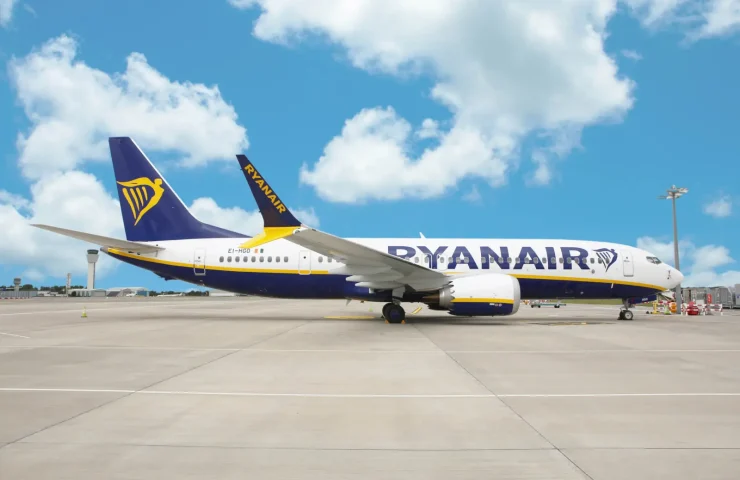
Ryanair is betting big on Morocco this winter

Over a decade of passion for writing, entirely dedicated to news about the air transport industry. On this site, I share the latest news from the aviation sector in Morocco with both rigor and enthusiasm.
The Irish low-cost giant is no longer hiding its ambitions. Ryanair has just officially announced, in partnership with the Moroccan National Tourist Office (ONMT), its most extensive winter schedule ever operated in the Kingdom. On the agenda: millions of additional seats, a new airbase in Rabat, and a strengthened network between Morocco and Europe.
A rapidly expanding network
For the 2026/2027 winter season, the airline will operate no fewer than 156 routes between Morocco and Europe, a figure that includes 17 brand-new itineraries. In total, 5.3 million low-cost seats will be offered, 580,000 more than the previous winter, representing a 12% increase. These flights will connect Morocco to 14 different European countries, confirming the Kingdom’s growing presence in the low-cost carrier’s continental network.
Three Moroccan cities are particularly benefiting from this expansion: Rabat gains seven new routes, while Marrakech and Agadir each gain five. Among the new destinations announced are Rabat-Stockholm, Rabat-Krakow, Marrakech-Wrocław, as well as Agadir-Milan, Agadir-Nuremberg, Agadir-Bratislava, and Agadir-Gdańsk. In total, thirteen Moroccan airports will see their services strengthened, including Fez, Tetouan, Essaouira, Ouarzazate, Dakhla, and Nador.
A new base at Rabat-Salé
A key feature of this announcement is the opening of Ryanair’s fifth base in Morocco, this time in Rabat, where two additional aircraft will now be stationed. The total fleet based in the Kingdom thus reaches 16 aircraft. The airline values this entire commitment at $1.6 billion.
This expansion also has social benefits: Ryanair states that its Moroccan operations support more than 8,500 local jobs, including approximately 480 pilot and cabin crew positions directly linked to its operations in the country.
A timeline also targeting 2030
This growth is no accident. It is part of the tourism and aviation development strategy that Morocco has set for itself with the 2030 World Cup, co-hosted with Spain and Portugal, in mind. By increasing direct connections to Europe, the Kingdom aims to position itself as a year-round destination, capable of absorbing a massive influx of visitors during the major football event.
Over a decade of passion for writing, entirely dedicated to news about the air transport industry. On this site, I share the latest news from the aviation sector in Morocco with both rigor and enthusiasm.